 Siddharth Saoji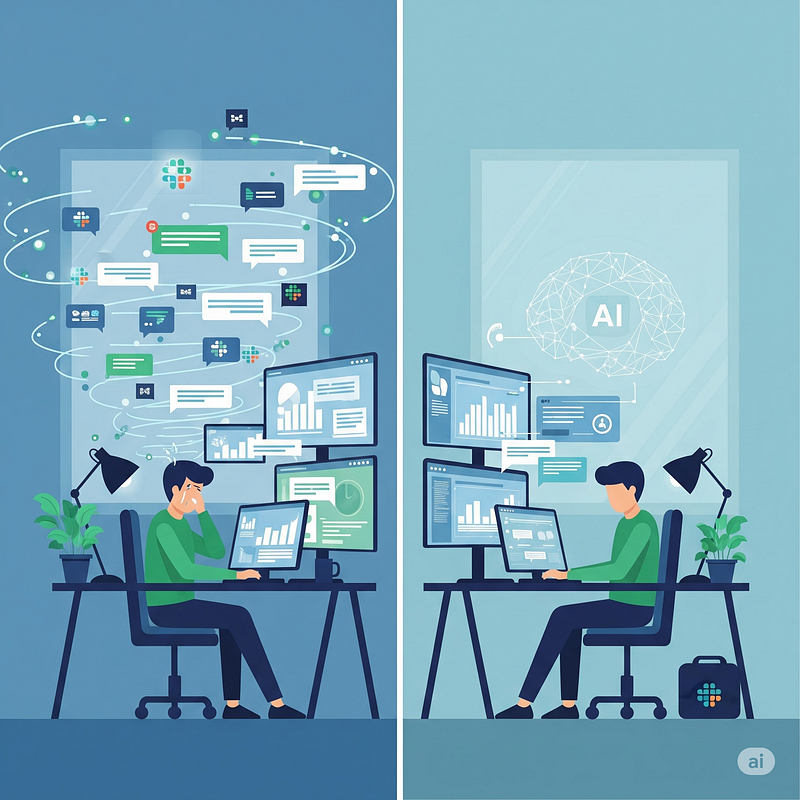
Picture this scenario: It’s October, and you’re racing against the clock to complete Q4 projects. Your Slack channel is exploding with messages from team members, stakeholders, and leadership. The constant notifications are destroying your focus, so you make a decision, you turn them off completely to carve out some uninterrupted work time.
Fast forward to January. Your projects are wrapped up, the organization has shifted into a slower post-holiday rhythm, and your Slack messages have dried up to a trickle. But those notifications are still turned off. Now you find yourself constantly checking Slack manually, anxious about missing something important. This constant attention switching is sabotaging your focus just as much as the flood of notifications did months earlier. So you flip the switch again, turning notifications back on to break this cycle.
Note while, In both situations, your core objective was identical, ‘maintaining focus time’. Yet the actions you took were opposite.
The AI Agent Challenge
Now imagine delegating this decision making to an AI agent designed to autonomously manage your Slack notifications. How would it know to make the same decisions you did?
Its context. The AI agent needs continuous awareness of three critical elements:
- What you want (your objective: maintaining focus)
- What it can do (the available actions: Read environmental variables, toggle notifications on/off)
- What environmental variables matter (message frequency, your slack checking patterns)
The Context Window Constraint
A core challenge for AI agents is the finite nature of context window (amount of information agent can consider at one time); our slack notification manager agent would require October’s activity data to benchmark changes in January’s patterns.
To solve this problem, we summarize context from one window and transfer to the following one, so that every ‘decision making’ time the agent knows all that has happened. AI development environments like Cursor and Windsurf are good examples of this done well to manage complex codebases and large count of interactions.
Hence
Context is the foundation that transforms reactive automation into intelligent, adaptive assistance. The AI agent would mirror your decision making, only if you can identify and convey the context well.